Lasting from about 299 to 252 million years ago, the Permian was the final chapter of the Paleozoic Era. It was a time of incredible evolutionary leaps, the formation of a supercontinent, and ultimately, the greatest mass extinction in Earth’s history.
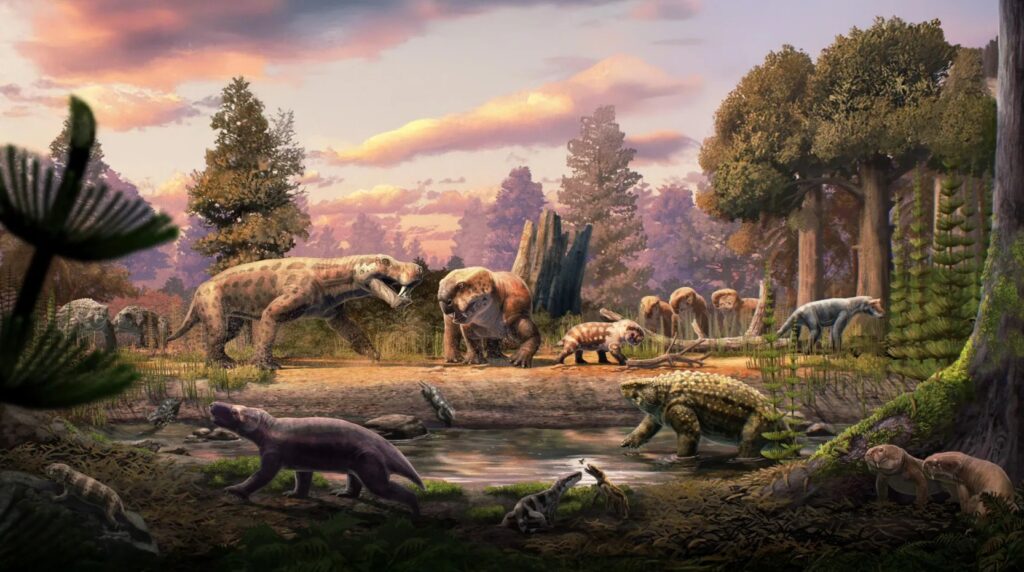

During this time, the Earth’s landmasses drifted together to form one giant supercontinent called Pangea. Because Pangea was so vast, the interior of the continent became very hot and dry. The massive coastal swamps of the Carboniferous began to disappear, replaced by vast deserts and seasonal forests. This shift in climate paved the way for new types of life that could survive away from the water’s edge.
Life on Land: The Rise of the Synapsids
The Permian was a Golden Age for land-dwelling animals. While many people think of dinosaurs when they think of “prehistoric monsters,” the stars of the Permian were actually the Synapsids.
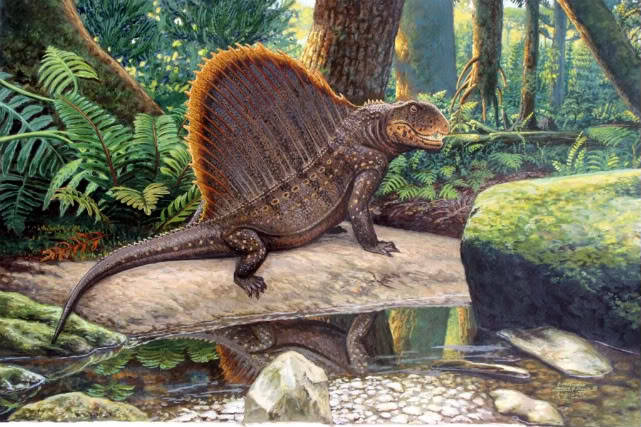
These were “mammal-like reptiles.” The most famous of these is probably Dimetrodon—you’ve likely seen them in toy sets with the big sail on their backs. Interestingly, Dimetrodon isn’t a dinosaur! It lived and went extinct millions of years before the first dinosaur ever appeared. These creatures were the ancestors of modern mammals.
We also saw the rise of the first modern conifers and the ancestors of the beetles and flies we see in our gardens today.
The Australian Connection: Glossopteris and Coal
Here in Australia, the Permian left a massive mark. Much of the coal we find in the Sydney and Bowen Basins was formed during the Permian.
Australia was part of the southern region of Pangea known as Gondwana. During the early Permian, Australia was actually positioned much closer to the South Pole, and we have evidence of massive glaciers covering parts of the continent.
As the climate warmed, vast forests of Glossopteris (a genus of seed ferns) spread across the landscape. These plants are incredibly important to science; their fossils were found across South America, Africa, India, Antarctica, and Australia, providing key evidence for the theory of Plate Tectonics.
The Great Dying
The Permian ended with the most catastrophic extinction event in Earth’s history, often called “The Great Dying.” Around 252 million years ago, a staggering 90% to 96% of all marine species and about 70% of terrestrial vertebrates disappeared. Scientists believe this was caused by massive volcanic eruptions in what is now Siberia, which pumped enormous amounts of carbon dioxide into the atmosphere, leading to rapid global warming and ocean acidification.
Watch PBS Eons: Could You Survive The Great Dying?
A catastrophic volcanic event in the Late Permian Period caused the biggest mass extinction of all time – known to us as the Great Dying. As a result, a large majority of terrestrial life would disappear, but our ancestors had the adaptations (and the healthy dose of luck) needed to survive – but would you?
It was a grim end to the period, but it cleared the stage for the rise of the dinosaurs in the Triassic period that followed.
Why does the Permian matter today?
Studying the Permian helps us understand how our planet responds to extreme climate change and volcanic activity. By looking at the fossil record and the rocks beneath our feet, we can see the resilience of life and the delicate balance of our global ecosystem.
Want to learn more? You can explore the rest of Earth’s history by checking out our Geologic Timescale resources here.