The Cretaceous is the final, spectacular chapter of the Mesozoic Era; the “Age of Dinosaurs.” While the Jurassic gave us giants, the Cretaceous Period 145 to 66 million years ago gave us a world that starts to look a bit more like home. It was a time of massive geological shifts, the arrival of bright colours in the plant world, and another mass extinction.
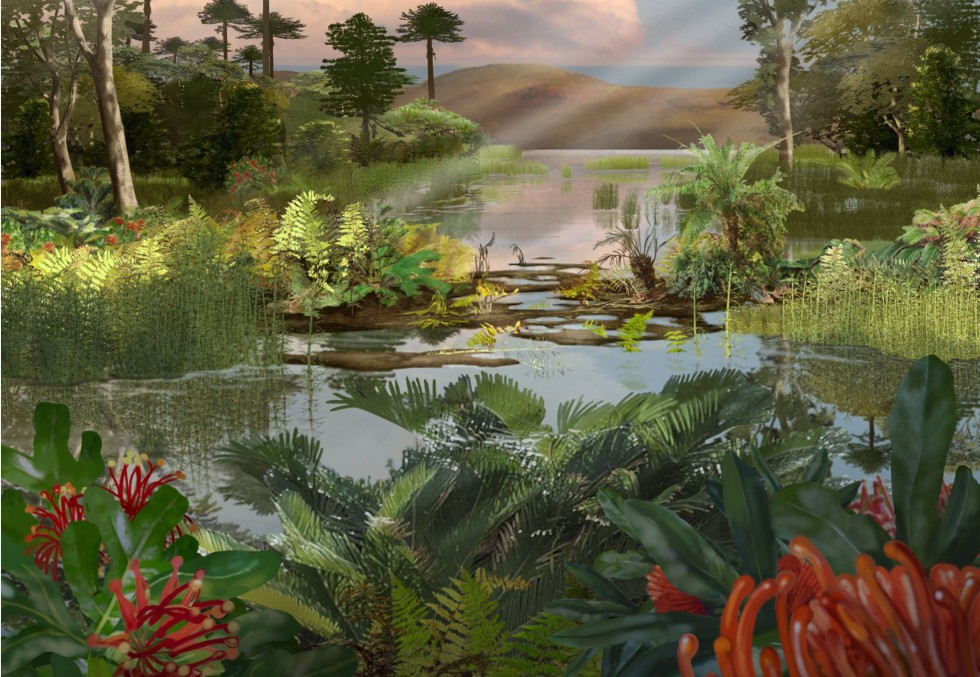
The Bloom Room: The First Flowers
For millions of years, the world was mostly shades of green and brown. But during the Cretaceous, Earth got a makeover. This was the period when Angiosperms (flowering plants) first appeared.
These plants evolved a genius new strategy: using nectar and bright colours to trick insects into moving their pollen around. This led to a massive “co-evolution” explosion of bees, butterflies, and moths. By the end of the Cretaceous, forests of oak, hickory, and magnolia were starting to replace the dominant ferns and cycads.
Australia’s Inland Sea
During the Early Cretaceous, Australia was a very different shape. Because sea levels were so high, a massive body of water called the Eromanga Sea cut right through the middle of the continent, effectively turning Australia into a group of large islands.
This shallow, cool sea was home to incredible marine reptiles like:
- Kronosaurus: A terrifying pliosaur with a head the size of a small car.
- Umoonasaurus: A long-necked leptocleidid plesiosaur
The Opal Connection: Ever wondered why Australia produces most of the world’s precious opals? When this inland sea eventually drained away, the silica-rich water left behind filled the gaps in the rock and even replaced the bones of dead animals. This is why we find “opalised” fossils—like the famous opalised dinosaur ‘Eric’ the Pliosaur—in places like Coober Pedy and Lightning Ridge!
Because Australia was still part of Gondwana and located much further south, some of our dinosaurs lived near the South Pole. They had to survive long, dark winters and freezing temperatures.
- Muttaburrasaurus: One of our most famous herbivores, found in Queensland. It had a large, hollow nose that it likely used to make loud trumpeting calls across the landscape.
- Minmi: A small, armoured ankylosaur that was built like a little tank to protect itself from predators.
- Leaellynasaura: A small dinosaur found at Dinosaur Cove in Victoria. It had unusually large eyes, likely to help it see and forage during the long, dark polar winters.
The Day the World Changed
The Cretaceous ended 66 million years ago with one of the most famous events in history: the Chicxulub asteroid impact.
A massive space rock slammed into the Yucatan Peninsula in Mexico, triggering tsunamis, wildfires, and a “nuclear winter” effect that blocked out the sun for years. This caused the collapse of food chains and led to the extinction of roughly 75% of all species on Earth, including all non-avian dinosaurs and the pterosaurs.
Why the Cretaceous Matters
The Cretaceous was the bridge to the modern world. It gave us our first flowers, our modern insect groups, and the ancestor of every bird you see today. It also left Australia with a rich legacy of opal treasures and unique fossils that prove life can thrive even in the harshest polar conditions.
See what happened after the dust settled as we enter the Cenozoic Era—the Age of Mammals. You can catch up on all our previous periods at our Geologic Timescale resources.