As Pangea shifted into the era of Gondwana, Australia became a unique sanctuary for dinosaurs. Because our continent was located so far south, many of our “locals” were extreme survivors, adapted to freezing polar winters and lush, swampy summers.
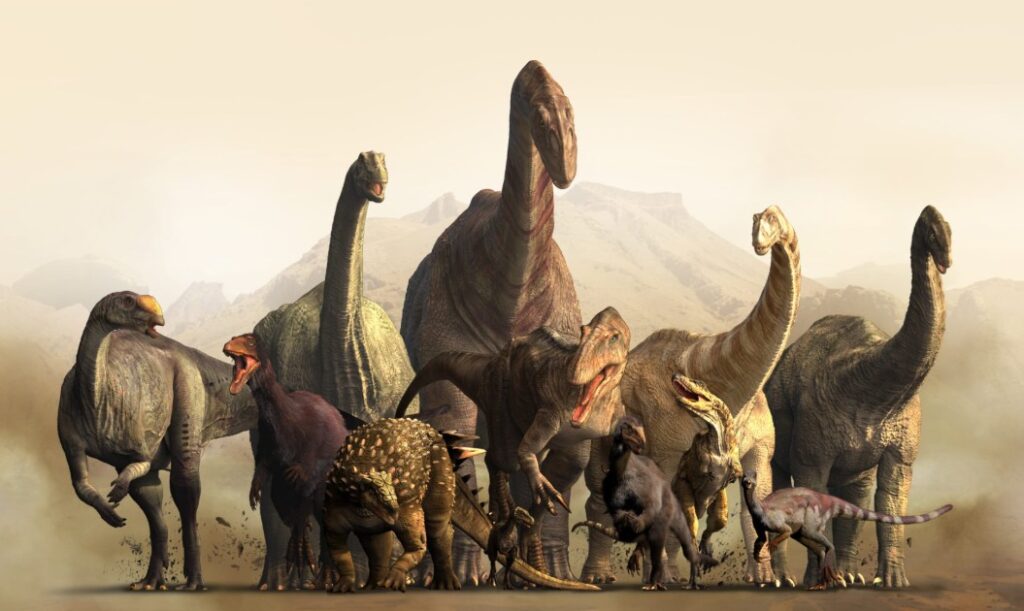
Many of Australia’s dinosaur fossils are currently being found in the Winton Formation of Central Queensland, dating back to about 95–100 million years ago.
Australovenator wintonensis (the Southern Hunter)
- Type: Carnivorous Theropod (Megaraptorid).
- Stats: 5–6 meters long; 2 meters tall.
- Features: Australia’s answer to the Velociraptor, but much larger. It had three massive, curved claws on each hand used for grappling prey. It was fast, agile, and likely the top predator of its time.
- Nickname: “Banjo” (after Banjo Paterson).
Diamantinasaurus matildae (Matilda’s Diamantina reptile)
- Type: Long-necked Sauropod (Titanosaur).
- Stats: 16–20 meters long; 2.5–3 meters tall at the hip.
- Features: A massive herbivore with a robust body and column-like legs. It lived alongside Australovenator in the lush floodplains left behind by the retreating Eromanga Sea.
- Nickname: “Matilda” (from Waltzing Matilda).
Muttaburrasaurus langdoni (Langdon’s Muttaburra lizard)
- Type: Large Ornithopod
- Stats: 7–9 meters long.
- Features: Famous for its unusual, hollow “bulbous” snout. Scientists believe this may have been used as a resonating chamber to make loud, trumpeting calls to communicate across the Pangean forests.
The Polar Specialists
When Australia was still attached to Antarctica, the southern parts of the continent including Victoria were inside the Antarctic Circle.
- Leaellynasaura: A small, turkey-sized herbivore. It had exceptionally large eye sockets, suggesting it evolved to see in the dark during the long, sunless polar winters.
- Koolasuchus: Not a dinosaur, but a giant amphibian (Temnospondyl). While these died out elsewhere during the Pangean transition, they survived in Australia’s cool southern rifts because the water was too cold for crocodiles to compete with them.
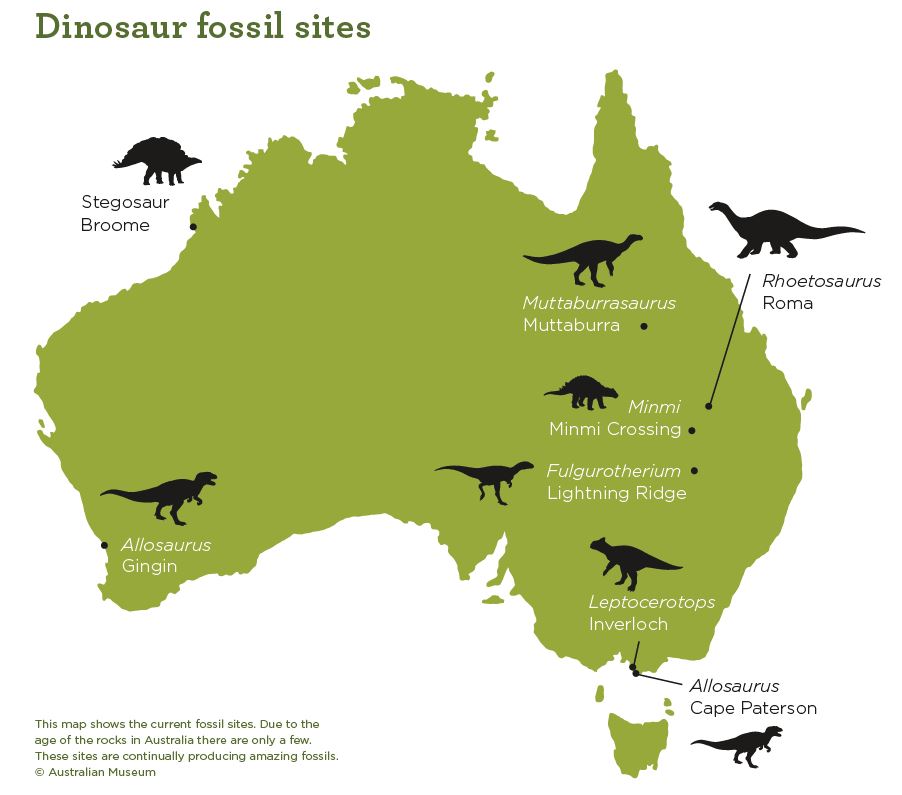
You can find some of these amazing fossils in the “Dinosaur Triangle” in Outback Queensland. There are some great dinosaur fossils, footprints and reconstructions to discover.
| Location | What to See |
| Winton | The Age of Dinosaurs Museum: Home to “Banjo” and “Matilda” and the world’s largest collection of Australian fossils. |
| Lark Quarry | The Dinosaur Stampede: 3,300 fossilized footprints showing a “snapshot in time” where a large predator chased a herd of smaller dinosaurs. |
| Richmond | Kronosaurus Korner: Focuses on the “Sea Monsters” (Pliosaurs and Plesiosaurs) that swam over Australia when the middle was an inland sea. |
| Hughenden | Flinders Discovery Centre: Home to “Hughie,” a life-sized skeletal replica of a Muttaburrasaurus. |
This video provides an exciting look at the latest dinosaur research in Australia, including the discovery of unique species that roamed the continent when it was still part of a polar ecosystem.
Are Dinosaurs still in Australia?
Technically, yes! Every time you see a Cassowary or an Emu, you are looking at a modern theropod. Many of the traits we see in birds, like the scaly legs, nesting behaviours and three-toed footprints are a direct inheritance from their ancestors that roamed the ancient world.