
After Australia broke away from Antarctica in the Paleogene, it continued its steady trek northward. The Neogene Period, which lasted from about 23 million to 2.6 million years ago.
This period is a story of transition. As Australia drifted further into drier latitudes, our lush rainforests began to retreat, replaced by the vast grasslands and open woodlands we recognise today. This change in the menu (from soft leaves to tough grass) led to some of the most incredible “mega” evolution in our history.
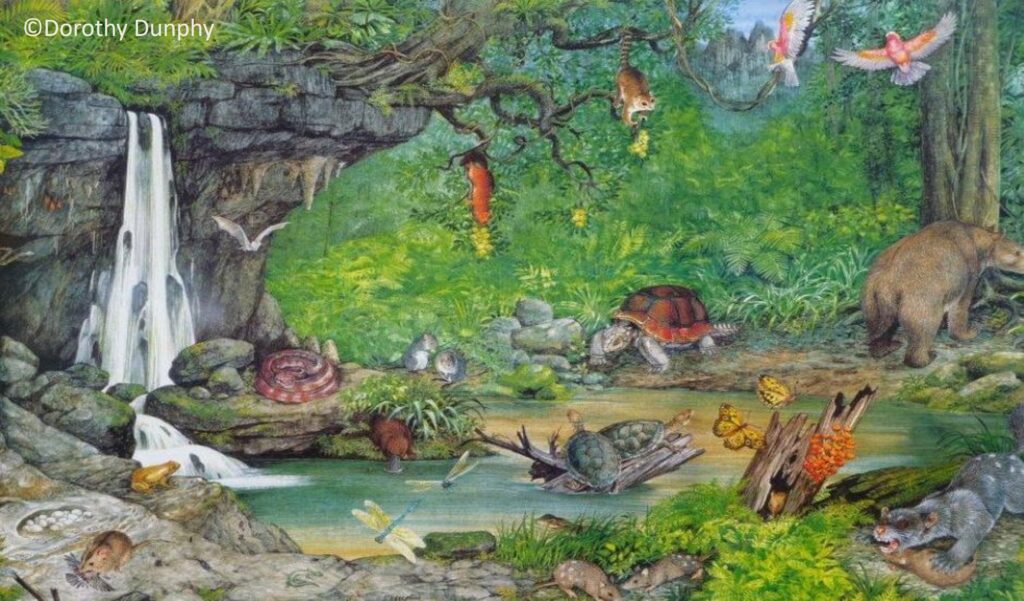
The Big Dry and the Great Grasslands
During the Neogene, the Earth’s climate continued to cool and dry out. For Australia, this was the “Big Dry.” As the continent moved north, the center started to become arid.
But where forests disappeared, grasslands exploded! Grass is tough and contains silica (which is like eating glass), so animals had to evolve special teeth and stomachs to deal with it. This is when we see the rise of the modern grazers; the ancestors of our kangaroos and wallabies.
Riversleigh: Australia’s Fossil Goldmine
If you want to know what was happening in Australia during the Neogene, you have to look at Riversleigh in north western Queensland. It is one of the world’s most important fossil sites! The fossils there tell us about a time when Australia was a “weird and wonderful” place. We’ve found:
- Fanged Kangaroos: Small kangaroos that didn’t hop but scurried, and they had literal fangs!
- Drop Crocs: Quinkana, a land-dwelling crocodile with long legs for running after prey.
- Thingodonta: A strange marsupial with giant, especializado teeth unlike anything alive today.
The Age of Megafauna Begins
As we moved into the later part of the Neogene (the Pliocene), Australian animals started to get huge. This was the beginning of the Megafauna.
- Diprotodon: The earliest ancestors of the giant wombat-like Diprotodon started appearing.
- Megalania: Massive monitor lizards (think of a Goanna the size of a bus!) began to dominate the food chain.
- Giant Flightless Birds: The Dromornithids, often called “Demon Ducks of Doom,” were massive birds that stood up to 3 metres tall.
Terror in the Oceans: The Megalodon
While things were getting big on land, the oceans were home to the ultimate predator. The Megalodon (Otodus megalodon) ruled the seas during the Neogene. This shark was roughly three times the size of a Great White! We find their giant, serrated teeth in fossil beds along the Victorian coast, proving these giants patrolled our waters as the Australian plate moved north.
Why the Neogene Matters
The Neogene is when the “modern” Australian identity was forged. Our plants adapted to fire and drought, and our animals became masters of the great outdoors. This period shows us how life adapts when the environment changes from a wet “Greenhouse” to a dry “Icehouse” world.
Are you ready for the final chapter? Next time, we reach the Quaternary Period—the age of ice, the peak of the Megafauna, and the arrival of humans. You can check out our full geological timeline over at our Education Resources.