After the “Great Dying” of the Permian and the recovery of the Triassic, the Jurassic Period, lasted from about 201 to 145 million years ago. The world was warming up, the continents were moving and life was getting big.
At the start of the Jurassic, the supercontinent Pangea began to crack and drift apart. This split created the Atlantic Ocean and separated the land into two massive chunks: Laurasia in the north and Gondwana in the south (which included our home, Australia).
The climate was hot and humid. There were no polar ice caps, and vast, lush rainforests spread across the globe. This “greenhouse” environment provided the perfect buffet for the largest animals to ever walk the Earth.
The Rise of the Titans
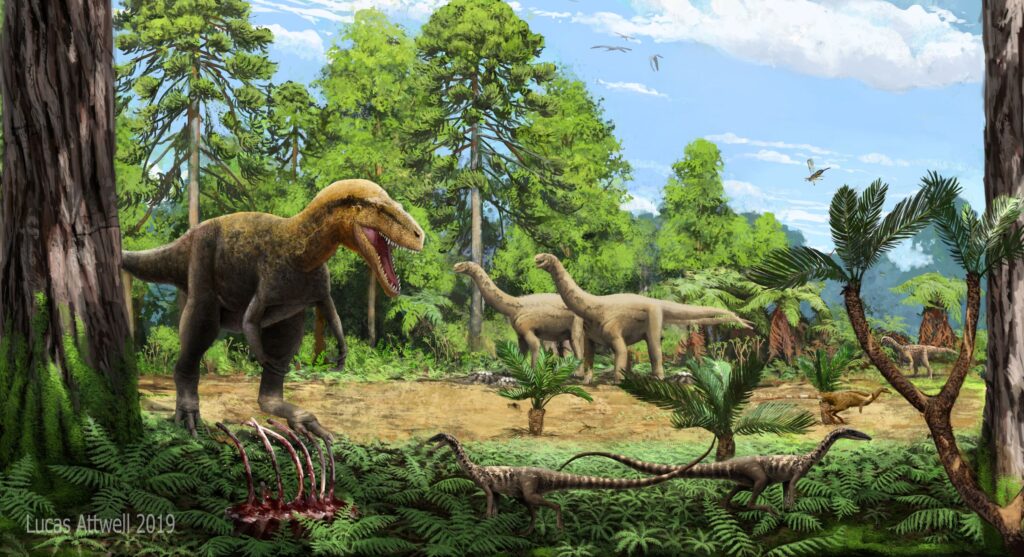
The Jurassic was the era when dinosaurs truly took over. With the Triassic extinctions out of the way, dinosaurs evolved to fill every available niche.
- The Giants: This was the age of the Sauropods—long-necked behemoths like Brachiosaurus and Diplodocus. These were the largest land animals to ever live, evolving massive bodies to reach the tops of the Jurassic’s towering trees.
- The Predators: Famous hunters like Allosaurus and Ceratosaurus were the apex predators of the landscape.
- Taking to the Skies: This period saw a massive evolutionary leap—the appearance of the first birds! Archaeopteryx is the most famous example, showing a beautiful transition between feathered dinosaurs and the birds we see in our backyards today.
Australia’s Jurassic Park
Since we were part of Gondwana, we were located much further south, but because the world was so warm, we weren’t frozen. Instead, much of Australia was covered in vast river systems and forests of conifers, ginkgos, and cycads.
Fossil evidence provide an incredible Jurassic “snapshots”:
- Talbragar Fish Beds (NSW): Near Gulgong, there is a world-famous site containing thousands of exquisitely preserved Jurassic fish, along with many plant fossils and even the occasional insect. It gives us a crystal-clear look at a 150-million-year-old freshwater ecosystem.
- Footprints in the Sand: In Western Australia, near Broome, and in the Surat Basin of Queensland, we find massive dinosaur trackways. These footprints tell us that sauropods and theropods were stomping across the Australian landscape long before the continent broke away.
The Forests of the Jurassic
If you walked through a Jurassic forest, you wouldn’t see any flowers! Angiosperms (flowering plants) hadn’t evolved yet. Instead, the world was a sea of green.
- Conifers were the dominant trees.
- Cycads were so common that the Jurassic is sometimes called the “Age of Cycads.”
- Ferns and Horsetails covered the ground, providing food for the smaller herbivores.
Did you know? Some of the “living fossils” we have in Australia today, like the Wollemi Pine, have ancestors that date back to this time. Walking through a grove of these trees is about as close as you can get to visiting the Jurassic!
The Jurassic was a period of biological “scaling up.” It shows us how life responds to a warm, high-CO2 environment with abundant resources. It’s also the period that gave us the ancestors of birds and the first truly diverse groups of mammals. They were still very small and mostly lived in the shadows of the dinosaurs.
See what happened when the flowers finally bloomed in the Cretaceous. You can explore more about our ancient past on the Geologic Timescale page.