After the icy “deep freeze” that ended the Ordovician, the Earth began to warm up, and the oceans started to rise. The Silurian Period, which lasted from about 443 to 419 million years ago.
While it might not be as famous as the “Age of the Fish” or “Age of the Dinosaurs,” the Silurian was a massive turning point for life on Earth. This was the era of “firsts”; the first coral reefs, the first jawed fish and the first brave animals to move onto land!
During the Silurian, the Earth’s climate stabilised. Much of the land was still gathered in the supercontinent of Gondwana, but the rising sea levels created vast, shallow, warm seas. These seas were the perfect nursery for life. We see the very first barrier reefs appearing, built not just by corals, but by sponges called stromatoporoids. Swimming through these reefs were:
- Trilobites: Still going strong and incredibly diverse.
- Brachiopods: Shelled animals that looked a bit like clams but are a completely different group.
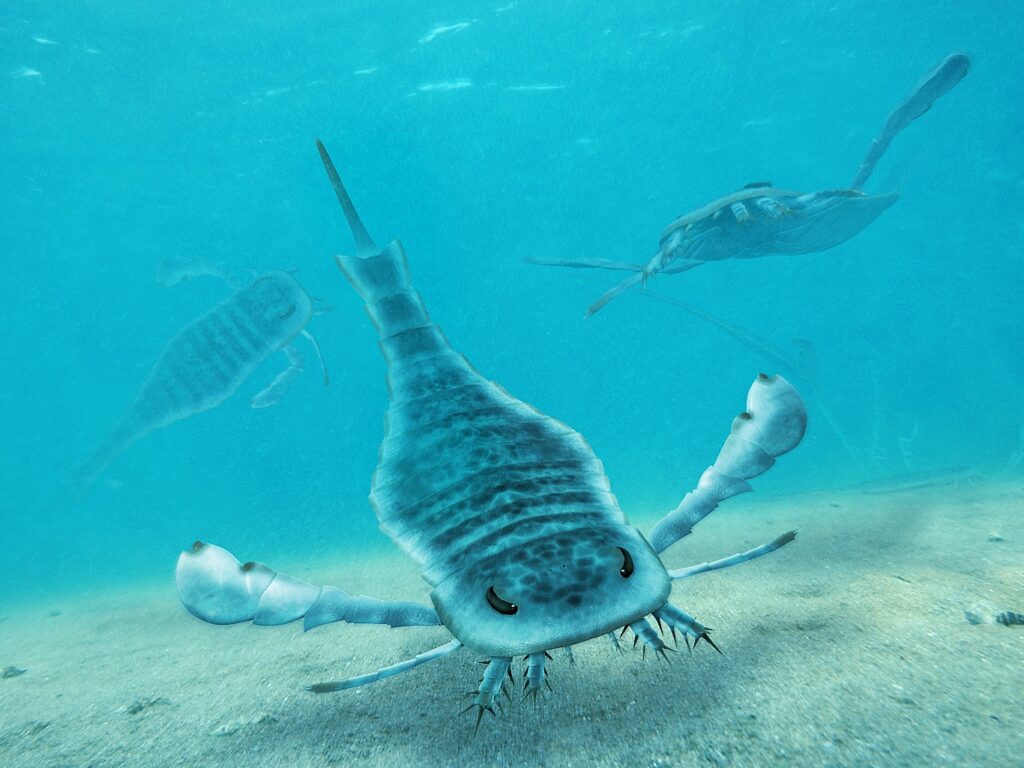
- Eurypterids (Sea Scorpions): These were the apex predators of the time. Some species grew up to two metres long! Imagine a scorpion the size of a surfboard lurking in the shallows.
One of the most important evolutionary “inventions” happened in the Silurian: the jaw. Before this, fish were generally “agnathans” (jawless), acting as bottom-feeders that sucked up nutrients. But during the Silurian, we see the appearance of the first jawed fish, like the Acanthodians (spiny sharks). Jaws meant animals could catch larger prey and defend themselves, sparking an evolutionary arms race that continues to this day!
Life Takes a Breath: The First Land Pioneers
For billions of years, the land had been mostly barren rock and dust. But in the Silurian, things finally started to turn green.
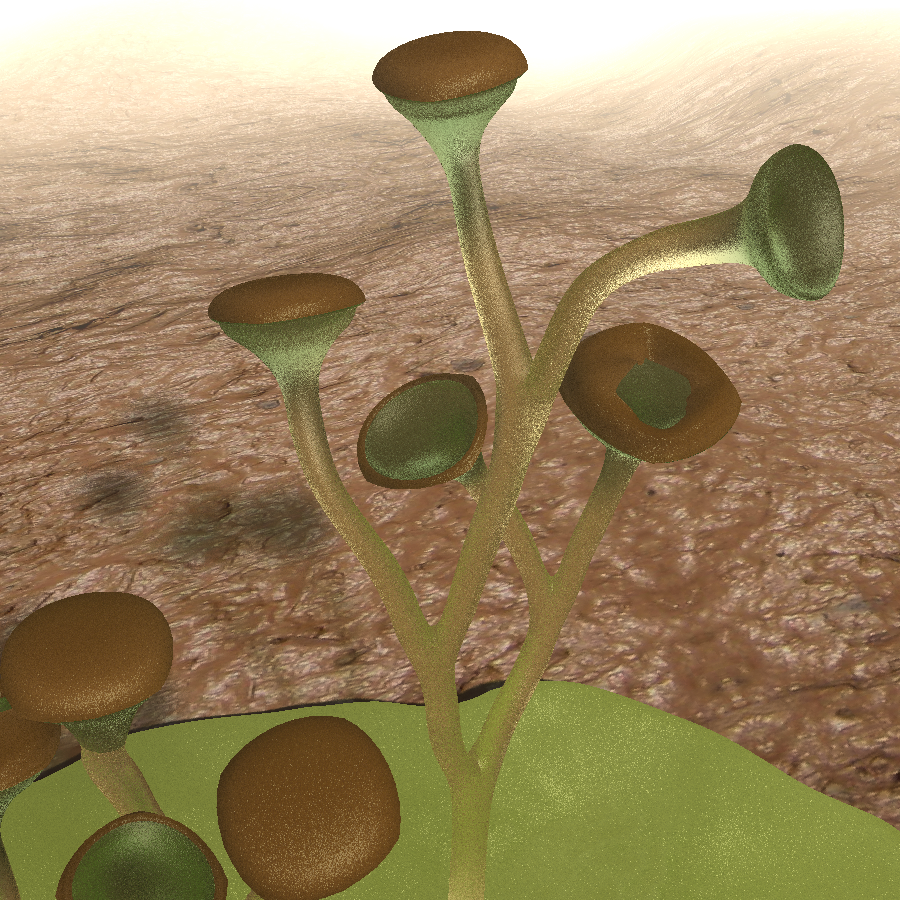
The first vascular plants, plants with internal structures to move water around appeared. The most famous is Cooksonia. It was tiny (only a few centimetres tall), but it was a pioneer! Following the plants were the first tiny land animals: ancestors of our modern millipedes, spiders, and centipedes.
Reconstruction of Cooksonia pertoni: CC BY 3.0 via Wikimedia Commons
The Australian Connection: Limestone and Volcanics
In Australia, the Silurian was a busy time for our geology, particularly along the East Coast. Much of New South Wales and Victoria was underwater or part of a series of volcanic islands known as the Lachlan Fold Belt.
Because of those warm, shallow seas massive limestone deposits were formed from ancient coral reefs. If you’ve ever visited the Jenolan Caves, Wellington Caves, or Yarrangobilly Caves, you are actually walking through the remains of a Silurian sea! The fossils found in these limestone walls tell us exactly what the Australian coastline looked like over 400 million years ago.
Find our more with Ginkgo Traces
You are swimming in the Silurian period, a time of spectacular underwater reefs, giant sea scorpions, and unusual vertebrates from jawless fish, to placoderms. And it’s a good thing you brought your walking shoes, because life on land is taking off, from the first arthropods, vascular plants, and even pillar-sized fungi!
The Silurian taught life how to survive outside of the water. Without those first tiny green stems of Cooksonia or the small arthropods that crawled onto the mud; the forests and animals of the later periods would never have existed.
Want to see what happened when those fish started to get even bigger? Check out our next stop in the Life in Devonian “Age of Fishes”.